
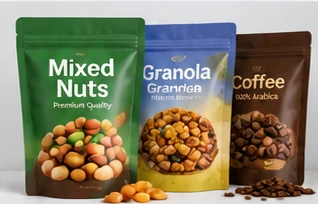
What is nitrogen flushing in food packaging?
Nitrogen flushing, also called nitrogen gas flushing or modified atmosphere packaging (MAP) in suitable applications, is a packaging process in which some of the air inside a package is displaced with food-grade nitrogen before the pack is sealed. The goal is to manage the atmosphere around the product, particularly the amount of residual oxygen in the headspace.
It is commonly considered for oxygen-sensitive foods such as nuts, roasted snacks, chips, coffee and some dry ingredients. The right process depends on the product, filling equipment and validated shelf-life target.
Why do food manufacturers use nitrogen?
1. Help reduce oxidation
Oxygen can contribute to oxidation in foods containing fats and oils. In products such as nuts and some snack foods, oxidation may lead to rancid flavours, aroma changes and quality loss. Reducing residual oxygen can help slow these reactions, when combined with appropriate materials and process control.
2. Help protect flavour and aroma
Some foods contain volatile aroma compounds that can change during storage. Managing the package atmosphere can help preserve the intended sensory profile. The actual result depends on the food formulation, oxygen level after flushing, storage temperature and package performance.
3. Provide cushioning for fragile products
In certain snack applications, the gas remaining in the pack can provide cushioning that helps reduce breakage during distribution. This effect depends on the package design, gas volume, product fragility and handling conditions; it should not be assumed for every product.
What does the packaging bag need to do?
Nitrogen flushing is only one part of the system. A bag must retain the intended atmosphere and withstand filling, sealing, transport and retail handling. Key packaging requirements include:
- Suitable gas barrier: the material structure should be selected to control oxygen ingress and, where relevant, moisture transmission over the required shelf life.
- Reliable heat seals: seal contamination, wrinkles, channel leaks or incorrect sealing conditions can allow gas exchange and compromise pack integrity.
- Puncture and handling resistance: sharp product edges, corners and distribution stresses should be considered, especially for nuts, seeds and hard snacks.
- Appropriate headspace and pouch dimensions: the bag size and fill level need to work with the gas-flushing method and filling equipment.
- Equipment compatibility: film stiffness, coefficient of friction, sealant layer and sealing window should be assessed against the actual packing line.
- Food-contact suitability: materials, inks, adhesives and other components should be assessed for the intended food type, contact conditions and target market.
How should you choose a material structure?
There is no single structure that is right for every nitrogen-flushed food. Laminated structures may combine printability, mechanical strength, heat-seal performance and barrier properties. Depending on the product and target performance, the technical review may consider PET, PE, metallized PET, aluminium foil or other suitable barrier layers.
Material selection should be based on the required oxygen transmission rate (OTR), water vapour transmission rate (WVTR), seal performance, product sensitivity, pack size, storage conditions and cost target. Ask for relevant test data and confirm whether the figures apply to the complete finished structure under comparable test conditions.
What should be checked before mass production?
- Define the product, formulation, fat content, moisture sensitivity and intended shelf life.
- Confirm the gas-flushing method, target residual oxygen and the packing-line sealing conditions with the equipment and process teams.
- Agree on the bag format, dimensions, material structure, zipper or other features, and print requirements.
- Evaluate seal integrity, package leakage, barrier performance and product quality during a suitable shelf-life study.
- Confirm food-contact documentation and applicable regulatory requirements for the target market.
Does nitrogen flushing make food safe by itself?
No. Nitrogen flushing is not a sterilization step and does not replace validated thermal processing, hygienic manufacture, hazard analysis, appropriate water-activity controls or other food-safety measures. Some foods can present microbiological risks in reduced-oxygen environments. The product process and storage conditions must be assessed by qualified food-safety professionals.
Related packaging solutions
Explore custom stand-up zipper pouches for retail snacks and nuts, or printed rollstock film for automated form-fill-seal packaging.